



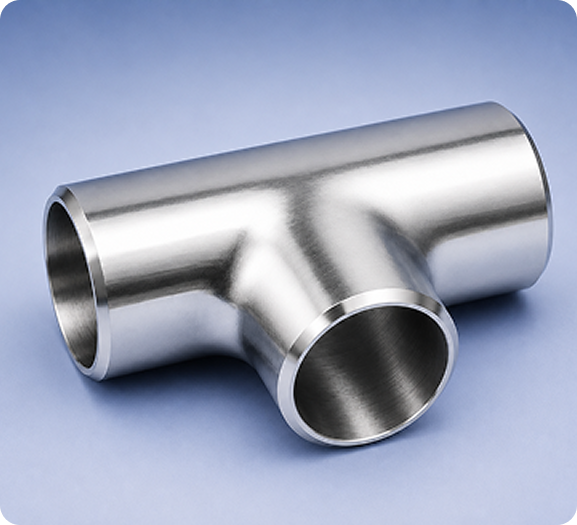
Tee Buttweld Fittings
Tee butt weld fittings enable branch-line integration in industrial piping networks. Veltronova offers equal and reducing tee configurations for U.S. buyers, targeting industrial supply hubs such as Houston, Chicago, Dallas, Los Angeles and New York. Buyers can specify dimensions, material grades and applicable standards to suit their piping requirements, operating conditions and project specifications.
Overview
In industrial piping, a tee fitting introduces a branch into a straight pipeline, helping route fluids or gases between connected lines. Equal tees maintain the same nominal diameter across all three openings, whereas reducing tees accommodate a smaller branch connection.
For the U.S. market, Veltronova focuses on supplying butt weld tees to industrial buyers and project procurement teams. Houston is a particularly relevant market for energy, refining and petrochemical applications, while Chicago, Dallas, Los Angeles and New York provide additional opportunities across manufacturing, infrastructure and industrial supply.
Correct fitting selection requires attention to nominal pipe size (NPS), wall thickness, material grade, branch configuration and operating conditions. ASME B16.9 is a commonly specified dimensional standard for factory-made wrought butt-welding fittings. Material requirements should be identified through the applicable ASTM or ASME specification, with weld-end preparation addressed under ASME B16.25 where required.
Carbon steel, stainless steel and alloy steel are common material categories for butt weld tees. The precise grade and available configuration should be confirmed against the project specification before ordering.
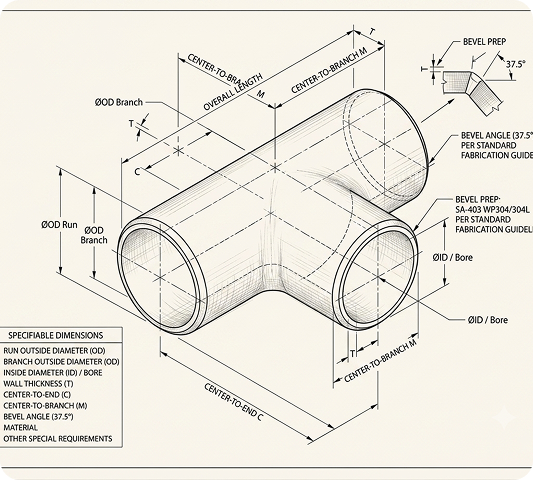
To request a quotation, specify the tee type, pipe and branch measurements, wall thickness, material grade, order quantity, documentation requirements and final delivery address. Engineering drawings and piping specifications are useful for checking dimensional and technical compatibility before procurement.
Technical Specifications
| Material | Grades Available | Standards | Size Range | Wall Thickness / Schedule | Types | End Finish |
|---|---|---|---|---|---|---|
| Carbon Steel Tee Fittings | ASTM A105, A234 WPB, A182 F11/F22 | ASTM, ASME B16.9, API | ½” – 48” | SCH 10 – SCH 160 | Equal Tee, Reducing Tee, Lateral Tee, High-Pressure Tee | Plain End, Beveled End |
| Stainless Steel Tee Fittings | SS 304/304L, 316/316L, 321, 347, 904L | ASTM A182, A403 | ½” – 48” | SCH 10 – SCH 160 | Equal Tee, Reducing Tee, Lateral Tee | Plain End, Beveled End, Polished |
| Alloy Steel Tee Fittings | ASTM A691, ASTM A182 F5, F9, F11, F22 | ASTM A234, ASME B16.9 | ½” – 48” | SCH 10 – SCH 160 | Equal Tee, Reducing Tee, High Pressure Tee | Plain End, Beveled End |
| Duplex / Super Duplex Tee Fittings | UNS S31803, S32205, S32750, S32760 | ASTM A815, ASME B16.9 | ½” – 24” | SCH 10 – SCH 160 | Equal Tee, Reducing Tee | Pickled & Passivated |
| Inconel Tee Fittings | Inconel 600, 601, 625, 718 | ASTM B366 | ½” – 12” | SCH 10 – SCH 160 | Equal Tee, Reducing Tee | Polished, Pickled |
| Hastelloy Tee Fittings | Hastelloy C22, C276 | ASTM B366 | ½” – 12” | SCH 10 – SCH 160 | Equal Tee, Reducing Tee | Polished, Pickled |
| Monel Tee Fittings | Monel 400, K500 | ASTM B366 / B564 | ½” – 12” | SCH 10 – SCH 160 | Equal Tee, Reducing Tee | Polished, Mill Finish |
| Titanium Tee Fittings | Titanium Gr.1, Gr.2, Gr.5, Gr.9 | ASTM B363 | ½” – 12” | SCH 5 – SCH 80 | Equal Tee, Reducing Tee | Pickled, Polished |
Features & Advantages of Tee Buttweld Fittings

Designed to reduce pressure loss for efficient fluid flow.

Manufactured to tight tolerances for perfect alignment .

Beveled ends ensure strong weld joints with excellent structural integrity.

Engineered to withstand demanding pressure across critical applications.

Manufactured from alloy materials for long-lasting durability.

Built for reliable performance in harsh industrial environments.
Applications Across Industries

Oil & Gas
Used in upstream, midstream and downstream pipeline systems.

Petrochemical
Used in upstream, midstream and downstream pipeline systems.

Power Generation
Used in upstream, midstream and downstream pipeline systems.

Chemical Processing
Used in upstream, midstream and downstream pipeline systems.

Marine & Offshore
Used in upstream, midstream and downstream pipeline systems.

Water Treatment
Used in upstream, midstream and downstream pipeline systems.
Frequently Asked Questions
Technical questions on our Tee Buttweld Fittings, answered by our engineering team.
Tee fittings allow engineers to introduce a branch line into an existing piping route. Depending on the system design, this connection can distribute process media to another destination or bring flow paths together. Typical installations include chemical processing units, refineries, energy facilities and industrial plants.
Choose an equal tee when the branch and main pipe have the same nominal diameter. A reducing tee is appropriate when the branch connection requires a smaller nominal diameter. The piping design, required flow capacity and connected pipe dimensions determine which configuration is suitable.
ASME B16.9 addresses factory-made wrought butt-welding fittings, including dimensional requirements. ASME B16.25 covers the preparation of butt-welding ends. Buyers should identify the applicable requirements in their purchase specification and confirm that the selected fitting meets the governing piping code.
Start with the project’s material specification and evaluate operating temperature, pressure, corrosion exposure and process-media compatibility. Carbon steel, stainless steel and alloy steel are common choices for different services. More specialized alloys should be specified only after confirming engineering suitability and supplier availability.
The fitting must correspond to the connected piping in terms of nominal pipe size, run and branch dimensions, and specified wall thickness or schedule. Material grade and dimensional standard must also be established. Isometric drawings and piping class documents help clarify requirements for complex installations.
Pressure suitability depends on the fitting’s material properties, wall dimensions, temperature limits, manufacturing quality and the design code governing the complete piping system. Engineers must verify these factors together; the presence of a butt-weld connection does not, by itself, establish a pressure rating.
Houston and the wider Texas Gulf Coast are important target markets for energy, refining and petrochemical projects. Chicago and Dallas–Fort Worth offer additional industrial and distribution opportunities, while Los Angeles and the New York metropolitan area provide other potential procurement markets. Buyers should compare technical compliance, total landed cost and delivery commitments rather than relying on location alone.
Confirm the country of origin, material specification, applicable standards, customs classification, import duties and any trade measures affecting the shipment. Project-specific sourcing restrictions may also apply. Agree on inspection documents, shipping terms, packaging and delivery schedules before issuing the purchase order.
A useful enquiry identifies the fitting configuration, run and branch sizes, schedule or wall thickness, material grade, applicable standard and required quantity. Include the delivery ZIP code, requested documentation and inspection criteria. Drawings or a piping class specification can reduce clarification cycles during technical review.
Review the purchase-order requirements against the documents provided by the supplier. Depending on the agreed quality plan, these may include material test reports, heat-number traceability, dimensional inspection results and specified non-destructive examination records. Confirm the scope of inspection and documentation before placing the order.
Need the Right Industrial Components for Your Project?
Connect with our engineering team for product recommendations, technical assistance and quotations.
Contact Us