



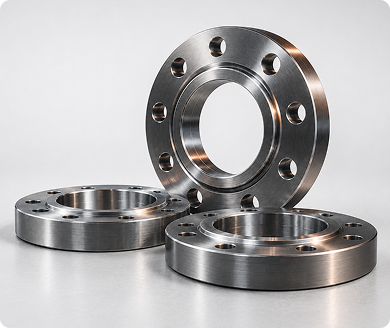
RTJ Flanges
Where a piping specification calls for a metallic ring-joint seal, the flange groove and gasket profile must be engineered to work as a compatible pair. Veltronova serves U.S. sourcing requirements for ring type joint flanges, with Houston, Texas among its priority markets for energy and process industries. Share your dimensional specification, pressure class, material grade and required ring designation to begin a technical quotation review.
Overview
Ring type joint flanges are used in piping and equipment connections designed around a metallic sealing element. Unlike a conventional raised-face arrangement, the RTJ interface relies on a specifically machined groove that accommodates a matching metal ring. Joint integrity depends on the compatibility and condition of the mating surfaces, the correct ring profile and proper assembly.
Veltronova targets U.S. industrial procurement, including Houston and the wider Gulf Coast, where energy, refining and petrochemical projects create demand for specialised piping components. Buyers should specify the actual equipment and service requirements rather than select a flange solely by industry or pressure category.
Technical identification begins with the flange standard, nominal pipe size, pressure class, material specification and facing arrangement. ASME B16.5 and ASME B16.47 apply to different flange size ranges and configurations, while ASME B16.20 addresses metallic gaskets, including ring-joint types. API 6A requirements apply to equipment within that standard's scope and should not be assumed to govern every RTJ connection.
Ring selection also requires attention to the groove design. R, RX and BX profiles serve different arrangements and must not be treated as interchangeable. Material compatibility, operating conditions and mating equipment should be reviewed together before a purchase is approved.
For a technical enquiry, provide the equipment or piping specification, flange dimensions, material grade, pressure class, ring designation, quantity and destination. Include drawings and any mandatory inspection or documentation requirements so the proposed supply can be assessed against the project.
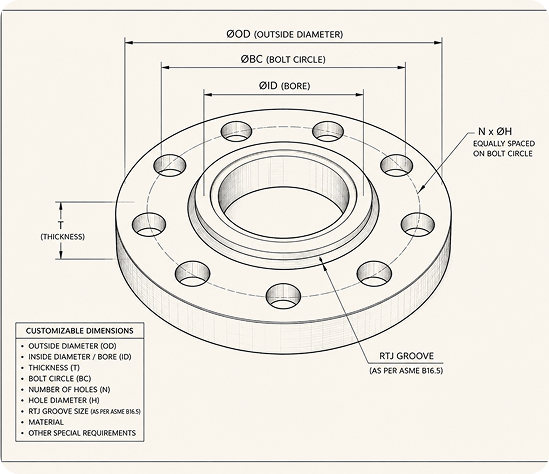
Technical Specifications
| Material | Grades Available | Standards | Size Range | Pressure Class | Types | Face Finish |
|---|---|---|---|---|---|---|
| Carbon Steel RTJ Flanges | ASTM A105, A350 LF2 | ASME B16.5, ASME B16.47, ANSI | ½” – 60” | Class 150 – Class 2500 | Weld Neck RTJ, Blind RTJ | Ring Type Joint Face |
| Stainless Steel RTJ Flanges | SS 304/304L, 316/316L, 321, 347, 904L | ASTM A182, ASME B16.5 | ½” – 60” | Class 150 – Class 2500 | RTJ Weld Neck, RTJ Blind Flange | Machined RTJ Groove, Polished |
| Alloy Steel RTJ Flanges | ASTM A182 F5, F9, F11, F22, F91 | ASTM A182, ANSI B16.5 | ½” – 48” | Class 300 – Class 2500 | High Pressure RTJ Flanges | Ring Joint Finish |
| Duplex / Super Duplex RTJ Flanges | UNS S31803, S32205, S32750, S32760 | ASTM A182 | ½” – 48” | Class 150 – Class 2500 | RTJ Weld Neck, RTJ Blind | Pickled & Passivated |
| Inconel RTJ Flanges | Inconel 600, 601, 625, 718 | ASTM B564 | ½” – 24” | Class 150 – Class 2500 | RTJ Flanges | Polished, Machined Finish |
| Hastelloy RTJ Flanges | Hastelloy C22, C276 | ASTM B564 | ½” – 24” | Class 150 – Class 2500 | RTJ Ring Joint Flanges | Polished Finish |
| Monel RTJ Flanges | Monel 400, K500 | ASTM B564 | ½” – 24” | Class 150 – Class 2500 | RTJ Weld Neck Flanges | Machined Finish |
| Titanium RTJ Flanges | Titanium Gr.1, Gr.2, Gr.5 | ASTM B381 | ½” – 24” | Class 150 – Class 1500 | RTJ Industrial Flanges | Pickled, Polished |
Features & Advantages of RTJ Flanges

Improves stress distribution for enhanced structural integrity.

Improves stress distribution for enhanced structural integrity.

Improves stress distribution for enhanced structural integrity.

Improves stress distribution for enhanced structural integrity.

Improves stress distribution for enhanced structural integrity.

Improves stress distribution for enhanced structural integrity.
Applications Across Industries

Oil & Gas
Used in upstream, midstream and downstream pipeline systems.

Petrochemical
Used in upstream, midstream and downstream pipeline systems.

Power Generation
Used in upstream, midstream and downstream pipeline systems.

Chemical Processing
Used in upstream, midstream and downstream pipeline systems.

Marine & Offshore
Used in upstream, midstream and downstream pipeline systems.

Water Treatment
Used in upstream, midstream and downstream pipeline systems.
Frequently Asked Questions
Technical questions on our RTJ Flanges, answered by our engineering team.
An RTJ flange should be identified by its governing standard, nominal pipe size, pressure class, material specification and ring-joint groove arrangement. Where the application requires it, include the bore, facing details and mating equipment information. These details help distinguish products that may appear similar but are not necessarily compatible.
The defining feature is its grooved sealing interface, designed to accept a metallic ring rather than a conventional flat or raised-face gasket. The sealing components must match the intended joint design, and the assembly must be installed according to the applicable engineering procedure.
Start with the flange or equipment specification and confirm the required ring designation against the relevant standard and groove geometry. R, RX and BX rings belong to different design arrangements; a substitution should not be made merely because a ring appears to fit. For specialised equipment, verify the requirements with the responsible engineer or equipment manufacturer.
The specification should identify the standard applicable to the flange and the one governing its gasket, where relevant. ASME B16.5 and ASME B16.47 cover different categories of flanges, while ASME B16.20 covers metallic gaskets, including ring-joint gaskets. API 6A is relevant to specified wellhead and tree equipment. Confirm the required editions and scope for the actual application.
The material must be appropriate for the process medium, design temperature, pressure, corrosion exposure and project requirements. A grade suitable for one service may not be acceptable in another. The purchase specification should identify the required material standard and grade, with substitutions subject to engineering approval.
Inspect the groove and sealing surfaces for scratches, corrosion, deformation and other damage that could compromise the joint. Confirm the correct ring specification and follow the applicable inspection and assembly procedure. If the groove condition or dimensional acceptability is uncertain, obtain a qualified engineering assessment before reuse.
No. Pressure class is only one part of the selection. The flange standard, material, operating temperature, dimensions, ring profile, mating components and governing piping or equipment code must also be considered. The complete joint must satisfy the design requirements for the intended service.
Procurement teams serving Houston and the wider Gulf Coast should establish the required specification, material grade, ring arrangement, inspection scope, delivery schedule and destination before comparing quotations. For imported products, include freight, customs-related costs and project sourcing conditions in the commercial assessment. Geographic relevance does not itself establish local inventory or immediate availability.
Agree the exact product specification, country of origin, quantity, pricing basis, delivery terms, manufacturing schedule and documentation included in the order. Identify any mandatory inspections, traceability records or third-party approvals in writing. Also establish how technical deviations or substitutions will be reviewed and authorised.
Submit a complete enquiry containing the applicable standard, size, class, material grade, groove or ring designation, quantity and delivery destination. Attach drawings, equipment details and project inspection requirements where applicable. A clearly defined specification reduces clarification rounds and helps the supplier assess the requirement before issuing a quotation.
Need the Right Industrial Components for Your Project?
Connect with our engineering team for product recommendations, technical assistance and quotations.
Contact Us