



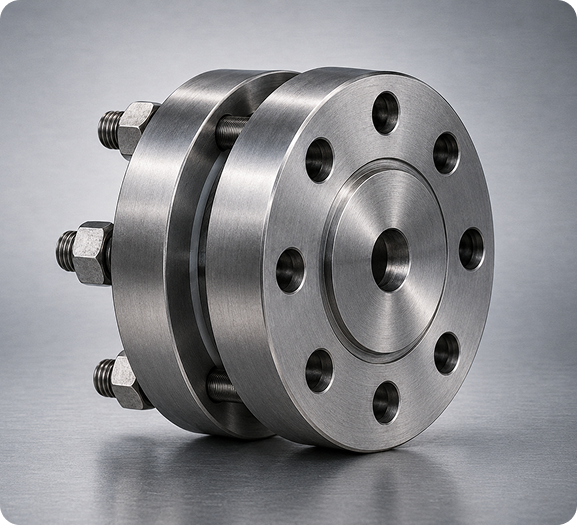
Orifice Flanges
Orifice flanges support differential-pressure flow measurement by holding an orifice plate and providing pressure taps. Veltronova supplies orifice flange solutions from India for U.S. projects, targeting Houston, Chicago, Dallas, Los Angeles and New York. Specify NPS, class, material, facing, tap arrangement and standard so the assembly can be reviewed against your flow-measurement and piping requirements. Include quantity and ZIP code for RFQs.
Overview
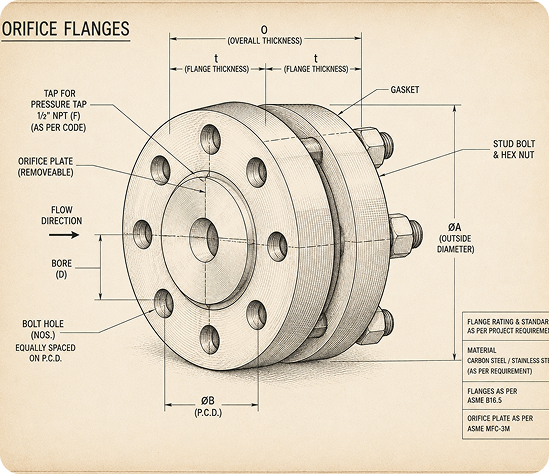
Orifice flanges are used in differential-pressure flow measurement. Installed with an orifice plate, they provide pressure taps on either side of the restriction; the measured pressure difference helps determine flow when the system is correctly designed and calibrated.
Veltronova targets U.S. industrial buyers, including Houston and other major markets. Orifice flanges are used in oil and gas, refining, petrochemical processing, power generation and chemical plants where flow measurement is required.
ASME B16.36 covers orifice flanges within its scope. A purchase specification should state nominal pipe size (NPS), pressure class, material grade, facing, tap location and connection, orifice plate requirements, and any accessories. Confirm compatibility with the meter design, adjoining piping and applicable project code.
Material selection depends on process fluid, design pressure, temperature, corrosion conditions and governing material specification. Confirm availability for the required size, class, material and configuration rather than assuming every option is standard.
For a quotation, submit flange type, NPS, class, material specification, facing, tap arrangement, quantity, documentation requirements and U.S. delivery destination. Include flow-element details and a project drawing where applicable, so the requirement can be reviewed before pricing.
Technical Specifications
| Material | Grades Available | Standards | Size Range | Pressure Class | Types | Face Finish |
|---|---|---|---|---|---|---|
| Carbon Steel Orifice Flanges | ASTM A105, A350 LF2 | ASME B16.36, ANSI B16.5 | ½” – 24” | Class 300 – Class 2500 | Weld Neck Orifice, Slip On Orifice | Raised Face, RTJ Face |
| Stainless Steel Orifice Flanges | SS 304/304L, 316/316L, 321, 347, 904L | ASTM A182, ASME B16.36 | ½” – 24” | Class 300 – Class 2500 | Orifice Weld Neck Flange | RF, RTJ, Polished Finish |
| Alloy Steel Orifice Flanges | ASTM A182 F5, F9, F11, F22, F91 | ASTM A182, ASME B16.36 | ½” – 24” | Class 300 – Class 2500 | High Pressure Orifice Flanges | Raised Face, Ring Type Joint |
| Duplex / Super Duplex Orifice Flanges | UNS S31803, S32205, S32750, S32760 | ASTM A182 | ½” – 24” | Class 300 – Class 1500 | Weld Neck Orifice Flange | Pickled & Passivated |
| Inconel Orifice Flanges | Inconel 600, 601, 625, 718 | ASTM B564 | ½” – 12” | Class 300 – Class 1500 | Orifice Meter Flanges | Polished, Machined Finish |
| Hastelloy Orifice Flanges | Hastelloy C22, C276 | ASTM B564 | ½” – 12” | Class 300 – Class 1500 | Industrial Orifice Flanges | Polished Finish |
| Monel Orifice Flanges | Monel 400, K500 | ASTM B564 | ½” – 12” | Class 300 – Class 1500 | Orifice Pipe Flanges | Machined Finish |
| Titanium Orifice Flanges | Titanium Gr.1, Gr.2, Gr.5 | ASTM B381 | ½” – 12” | Class 300 – Class 1500 | Flow Measurement Flanges | Pickled, Polished |
Features & Advantages of Orifice Flanges

Improves stress distribution for enhanced structural integrity.

Improves stress distribution for enhanced structural integrity.

Improves stress distribution for enhanced structural integrity.

Improves stress distribution for enhanced structural integrity.

Improves stress distribution for enhanced structural integrity.

Improves stress distribution for enhanced structural integrity.
Applications Across Industries

Oil & Gas
Used in upstream, midstream and downstream pipeline systems.

Petrochemical
Used in upstream, midstream and downstream pipeline systems.

Power Generation
Used in upstream, midstream and downstream pipeline systems.

Chemical Processing
Used in upstream, midstream and downstream pipeline systems.

Marine & Offshore
Used in upstream, midstream and downstream pipeline systems.

Water Treatment
Used in upstream, midstream and downstream pipeline systems.
Frequently Asked Questions
Technical questions on our Orifice Flanges, answered by our engineering team.
An orifice flange is designed to hold an orifice plate in a pipeline and provide pressure-tapping points for differential-pressure measurement. The pressure difference across the plate is used to calculate the flow rate when the complete measurement system is properly designed and configured.
An orifice flange incorporates pressure taps for measuring pressure upstream and downstream of an orifice plate. A standard pipe flange generally connects piping or equipment without these dedicated measurement features. The correct choice depends on whether the piping system requires differential-pressure flow measurement.
ASME B16.36 covers orifice flanges within its defined scope. The purchase specification should also identify the applicable flange dimensions, material requirements, pressure class, pressure-tap configuration and any project-specific requirements. Confirm the relevant edition and scope with the responsible engineer before ordering.
Confirm the nominal pipe size (NPS), pressure class, material grade, facing, pressure-tap location and connection, applicable standard and quantity. The orifice plate, adjoining piping, measurement arrangement and required accessories must also be compatible with the specified design.
Material selection depends on the process medium, operating temperature, design pressure, corrosion exposure and governing material specification. Carbon steel, stainless steel and alloy steel may be appropriate for different services. The required grade and its availability should be verified against the project specification.
Pressure taps provide access to the pressure points needed by the differential-pressure measurement arrangement. Their location, connection type and configuration must be compatible with the specified measurement design. Incorrect or mismatched tapping arrangements can affect installation and measurement performance.
Veltronova targets U.S. procurement, including Houston, Texas, and other industrial markets. Buyers should provide the required specification and delivery destination so the product requirements, commercial terms, shipping arrangements and manufacturing feasibility can be reviewed before ordering.
A complete request should include: • Nominal pipe size and pressure class • Material grade and applicable standard • Flange facing and pressure-tap arrangement • Orifice plate or flow-element details • Quantity and required documentation • Final U.S. delivery location, including city and state Drawings and project specifications help clarify special requirements and reduce quotation delays.
No. Compatibility depends on the measurement design, flange dimensions, plate arrangement, pressure-tap configuration, process conditions and applicable standards. The complete assembly should be checked against the instrument manufacturer's requirements and the project's engineering specification.
Documentation should be agreed in the purchase order. Depending on project requirements and supplier capabilities, buyers may request material test reports, dimensional inspection records, material traceability and other specified inspection documents. Confirm the actual documentation scope before placing the order.
Need the Right Industrial Components for Your Project?
Connect with our engineering team for product recommendations, technical assistance and quotations.
Contact Us