


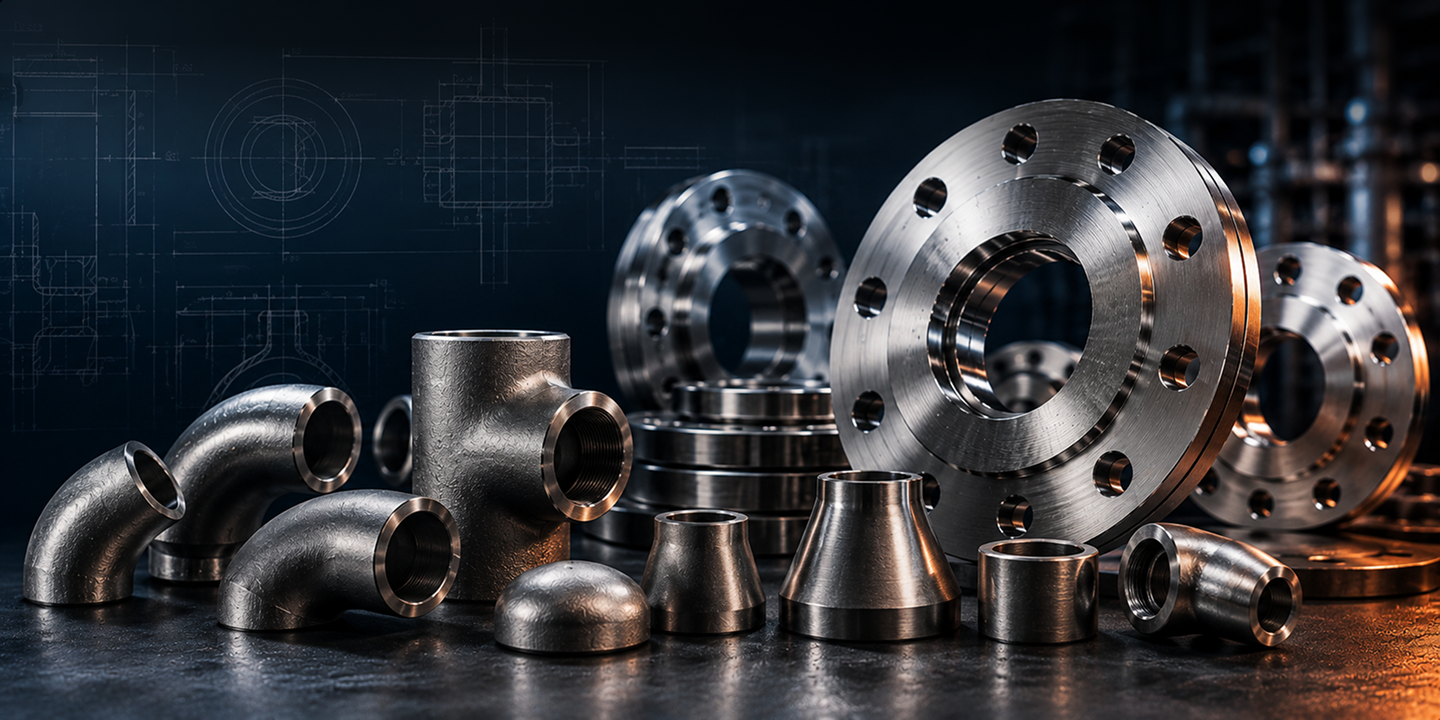
Industrial piping systems are built from a combination of components that work together to transport fluids, gases, steam, chemicals, and other process media safely and efficiently. While pipes form the main route through a system, components such as flanges, buttweld fittings, and forged fittings are equally important for creating connections, changing flow direction, controlling branch lines, and connecting piping to equipment.
Selecting the right piping components requires more than simply choosing a product based on size or price. Material grade, pressure rating, temperature, dimensions, applicable standards, connection type, service conditions, and inspection requirements all influence the suitability of a component.
This guide explains the major types of industrial piping components, their applications, commonly used standards, and the factors buyers should consider when sourcing them for industrial projects.
Understanding Industrial Piping Components
An industrial piping system can contain hundreds or thousands of individual components. Each component has a specific role within the system.
Flanges are generally used to create detachable connections between pipes and equipment. Buttweld fittings help change the direction or size of a pipeline and create branches. Forged fittings are commonly used for compact and robust connections, particularly in high-pressure and instrumentation applications.
The correct combination of these components helps improve system reliability while making inspection, maintenance, replacement, and future modifications easier.
Flange Types for Industrial Piping
Flanges are available in different designs to accommodate different connection methods and operating requirements. The appropriate type depends on the piping configuration, pressure class, temperature, maintenance requirements, and applicable engineering standard.
Slip On Flanges
Slip On Flanges are designed to fit over the outside of a pipe and are generally welded into position. Their relatively simple installation makes them suitable for many general-purpose industrial piping applications.
They are commonly considered where ease of fabrication and cost efficiency are important.
Blind Flanges
Blind Flanges are solid components used to close the end of a pipe or piping connection. They are useful when a section of a piping system needs to be isolated or when a pipeline may need to be extended in the future.
They are commonly used around vessels, valves, pipelines, and other equipment connections.
Socket Weld Flanges
Socket Weld Flanges are designed primarily for smaller-diameter piping applications where a socket connection and welding arrangement are required.
They can be suitable for applications where a compact connection is preferred.
Threaded Flanges
Threaded Flanges feature internal threads that allow them to be connected to externally threaded pipe. They can be considered for applications where welding is undesirable or difficult.
The selection of a threaded connection should take the operating pressure, temperature, and service conditions into account.
Lap Joint Flanges
Lap Joint Flanges are used with stub ends and can be advantageous in systems that require frequent assembly and disassembly.
Because the flange itself does not need to be welded directly to the pipe, this configuration can provide flexibility during maintenance and alignment.
Orifice Flanges
Orifice Flanges are specially designed for flow measurement systems. They are commonly used with orifice plates and associated instrumentation to measure flow within process piping.
They are frequently considered in process plants where accurate flow measurement is required.
Spectacle Blind Flanges
Spectacle Blind Flanges are designed to provide a visible method of isolating or opening a section of piping.
Their configuration allows operators to identify the condition of the line visually, making them useful in systems where positive isolation is important.
Long Weld Neck Flanges
Long Weld Neck Flanges feature an extended neck that provides additional reinforcement and a gradual transition between the pipe and flange.
They can be used in demanding piping and equipment applications where additional structural support is required.
RTJ Flanges
RTJ Flanges, or Ring Type Joint Flanges, are designed for applications requiring a specialized metal ring sealing arrangement.
They are commonly associated with high-pressure and high-temperature services where the correct sealing system is critical to reliable operation.
Custom Flanges
Not every industrial project can be served by standard dimensions. Custom Flanges can be manufactured according to project-specific requirements such as dimensions, drilling patterns, pressure classes, facing configurations, material specifications, and other engineering requirements.
Buttweld Fittings for Process Piping
Flanges are only one part of a complete piping network. Buttweld fittings are used where the pipeline needs to change direction, create a branch, reduce its diameter, or terminate a line.
These fittings are commonly welded directly to the pipe and can provide a continuous connection suitable for many process and industrial applications.
Elbows
Elbows are used to change the direction of a pipeline. Depending on the system design, different bend angles and configurations can be selected.
They are commonly used throughout process pipelines, chemical plants, power generation facilities, and industrial piping networks.
Tees
Tees are used to create a branch from a main pipeline. They are available in configurations designed to accommodate different branch and run sizes.
They can be used in process systems where fluid needs to be distributed between multiple lines.
Reducers
Reducers connect pipes of different diameters. They are important when a piping system needs to transition between larger and smaller pipe sizes while maintaining the required flow arrangement.
View Reducer Buttweld Fittings
End Caps
End Caps are used to close the end of a pipeline. They can be used in process piping, pressure systems, fabrication projects, and other industrial applications where a closed pipe termination is required.
View End Cap Buttweld Fittings
Forged Fittings for High-Pressure and Compact Connections
Forged fittings are manufactured for applications where a strong and compact connection is required. They are frequently used in instrumentation lines, high-pressure piping, process systems, and applications where space is limited.
Socket Weld Fittings
Socket Weld Fittings provide a welded connection in which the pipe is inserted into a socket before welding.
They are commonly used for smaller-diameter piping and applications where a compact connection is required.
Threaded Fittings
Threaded Fittings use threaded connections and can be useful in applications where welding is not preferred.
Selection should take into account pressure, temperature, fluid characteristics, and the applicable engineering requirements.
Forged Outlets
Forged Outlets are used to create branch connections from a main pipeline. They are useful in applications where a compact and robust branch connection is required.
They can be specified according to the main pipe size, branch size, pressure requirements, and applicable standard.
Standards for Industrial Piping Components
International and industry standards establish requirements for dimensions, materials, pressure classes, manufacturing, testing, and other characteristics.
The appropriate standard depends on the component and its intended application.
Common Flange Standards
Commonly referenced standards include:
ASME B16.5
ASME B16.47 Series A & B
MSS SP-44
API 6A
AWWA C207
EN 1092-1
BS
DIN
JIS B2220
Common Buttweld Fitting Standards
Common standards include:
ASME B16.9
ASME B16.28
MSS SP-43
MSS SP-75
MSS SP-95
MSS SP-119
EN 10253
DIN
JIS
Common Forged Fitting Standards
Depending on the product and application, commonly referenced standards include:
ASME B16.11
ASME B1.20.1
MSS SP-79
MSS SP-83
MSS SP-95
MSS SP-97
MSS SP-105
BS 3799
The applicable standard should always be confirmed against the project specification and service requirements before procurement.
Applications Across Industrial Sectors
Industrial piping components are used across a wide range of sectors.
Oil and Gas
Pipelines, processing facilities, terminals, and associated infrastructure require reliable piping connections and fittings designed according to the relevant service conditions.
Chemical Processing
Chemical plants use piping components throughout process lines, utility systems, storage facilities, and equipment connections.
Refineries
Refinery networks contain extensive piping systems that require components selected for pressure, temperature, fluid characteristics, and operational conditions.
Power Generation
Power plants use piping components throughout steam, water, fuel, cooling, and auxiliary systems.
Process Industries
Process plants depend on correctly selected piping components for transportation and management of fluids and gases.
Instrumentation Systems
Compact forged components are commonly used in instrumentation and control lines where space and connection reliability are important.
How to Select the Right Piping Component
Choosing an industrial piping component should begin with the technical requirements of the system.
Important factors include:
1. Pipe Size
The component must correspond correctly with the pipe outside diameter, nominal pipe size, and connection dimensions.
2. Pressure Rating
The required pressure class or pressure capability should be established before selecting the component.
3. Temperature
Operating and design temperatures can influence material selection and component suitability.
4. Material
The material grade should be compatible with the operating environment, mechanical requirements, and project specification.
5. Connection Type
The system may require a bolted flange, butt-welded fitting, socket-weld connection, or threaded connection.
6. Applicable Standard
The component should be manufactured according to the standard specified for the project.
7. Service Conditions
Fluid characteristics, corrosion considerations, pressure, temperature, cycling, and environmental conditions should all be considered.
8. Testing and Documentation
Depending on the application, material certificates, inspection reports, testing documentation, traceability, and third-party inspection may be required.
What Affects Industrial Piping Component Prices?
Industrial component pricing depends on several factors.
Material grade, component size, wall thickness, manufacturing process, pressure rating, machining requirements, surface finish, quantity, testing, certification, packaging, and delivery location can all influence the final price.
For this reason, comparing suppliers solely on the initial unit price may not provide a complete picture.
A better procurement decision considers:
Product quality
Material traceability
Manufacturing capability
Applicable standards
Inspection and testing
Documentation
Packaging
Delivery reliability
Technical support
Total project cost
Why Quality and Traceability Matter
Industrial piping components are often installed in systems where failure can result in production downtime, leakage, equipment damage, or safety risks.
For this reason, buyers should work with suppliers capable of providing appropriate quality documentation and traceability.
Depending on project requirements, documentation may include:
Material Test Certificates
Chemical Analysis
Mechanical Test Results
Dimensional Inspection Reports
Heat Number Traceability
Inspection Reports
Compliance Documentation
Third-Party Inspection Reports
The required documentation should be clearly defined before an order is placed.
Choosing an Industrial Piping Component Supplier
A reliable supplier should provide more than a product catalogue.
Buyers should evaluate the supplier's manufacturing capabilities, product range, quality procedures, technical knowledge, inspection systems, documentation, production capacity, packaging methods, and ability to meet delivery schedules.
For international projects, export experience and logistics capabilities are also important.
A supplier with experience across multiple piping component categories can simplify procurement by allowing customers to source different products from one supply chain.
A Complete Industrial Piping Product Range
A modern piping project may require several component categories rather than a single product.
The connection requirements may involve Slip On Flanges, Blind Flanges, Socket Weld Flanges, Threaded Flanges, Lap Joint Flanges, Orifice Flanges, Spectacle Blind Flanges, Long Weld Neck Flanges, RTJ Flanges, or Custom Flanges.
The piping layout may additionally require Elbows, Tees, Reducers, and End Caps.
For smaller-diameter or high-pressure applications, Socket Weld Fittings, Threaded Fittings, and Forged Outlets can provide the required connection arrangements.
Having access to a complete range of components can make procurement, technical coordination, documentation, and project management more efficient.
Conclusion
Industrial piping systems depend on the correct combination of pipes, connection components, fittings, and equipment interfaces. Selecting the right component requires careful consideration of dimensions, materials, pressure, temperature, standards, connection method, service conditions, and documentation.
From pipeline connections and process lines to refinery networks, chemical plants, power generation systems, and instrumentation applications, each component has a specific purpose within the overall system.
A reliable sourcing partner should be capable of supplying a broad product range while maintaining consistent quality, traceability, technical support, and documentation.
Whether a project requires standard products or customized solutions, making the selection based on engineering requirements rather than price alone can help improve reliability, maintainability, and long-term operational performance.
Frequently Asked Questions
What are the main types of industrial piping components?
The main categories include flanges, buttweld fittings, and forged fittings. Each category contains different products designed for specific connection and piping requirements.
What products are available for flange connections?
Common options include Slip On Flanges, Blind Flanges, Socket Weld Flanges, Threaded Flanges, Lap Joint Flanges, Orifice Flanges, Spectacle Blind Flanges, Long Weld Neck Flanges, RTJ Flanges, and Custom Flanges.
Which fittings are used to change pipeline direction?
Elbows are commonly used to change pipeline direction, while Tees create branches, Reducers connect different pipe sizes, and End Caps close pipeline ends.
What are forged fittings used for?
Forged fittings are commonly used for compact and robust connections, including high-pressure piping, instrumentation lines, and industrial process systems.
How do I choose the correct piping component?
Consider pipe size, pressure rating, operating temperature, material grade, connection type, applicable standard, service conditions, testing requirements, and project specifications.
Why are industrial standards important?
Standards provide requirements for dimensions, materials, manufacturing, pressure ratings, testing, and other characteristics, helping ensure that components are appropriate for their intended application.