



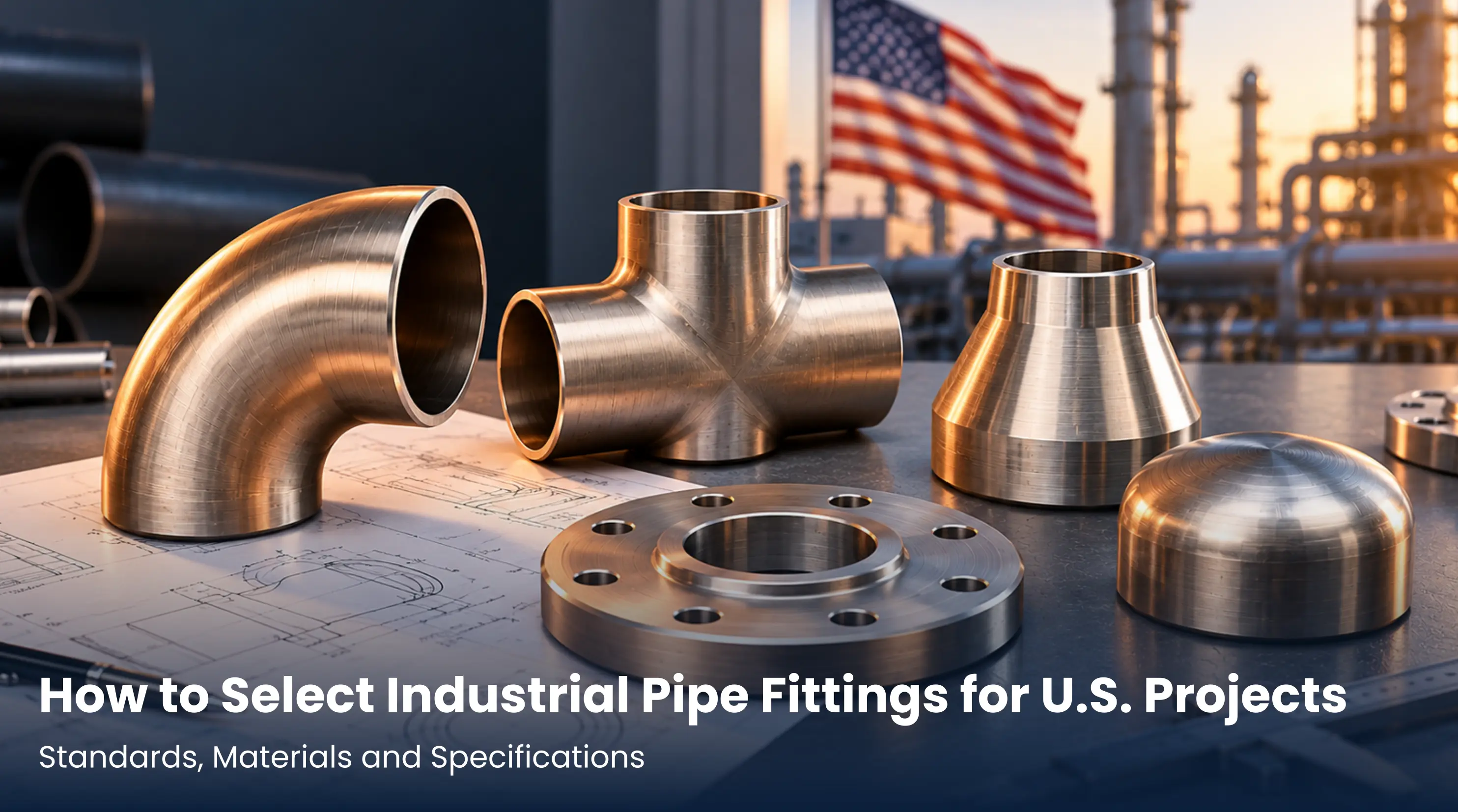
Selecting industrial pipe fittings for a U.S. project involves more than matching a nominal pipe size or choosing a familiar material grade. Engineers, contractors and procurement teams must consider the piping system’s design conditions, connection method, dimensional compatibility, material requirements and applicable codes. A fitting that looks correct on a purchase order may still be unsuitable if its wall thickness, pressure rating, material specification or end preparation differs from the approved design.
These decisions affect installation, inspection, maintenance and long-term reliability across industries such as oil and gas, chemical processing, power generation, water treatment and manufacturing.
For buyers sourcing elbows, tees, reducers, caps, flanges and forged fittings, the most effective approach is to establish the engineering requirements first and use them to prepare a complete request for quotation (RFQ). This guide explains the main selection criteria and shows how to communicate them clearly to a supplier.
1. Identify the Correct Fitting Type and Connection
Start by defining what the fitting must accomplish in the piping layout. Its function determines the geometry, connection type and dimensional requirements.
| Fitting type | Typical application | Details to specify |
| Elbow | Changes the direction of flow | Angle, radius, size and end connection |
| Tee | Creates a branch connection | Equal or reducing configuration |
| Reducer | Connects different pipe sizes | Concentric or eccentric design, end sizes |
| Cap | Closes a pipe end | Size, wall thickness and connection |
| Butt-weld fitting | Connects pipe ends by welding | verify weld-end preparation, matching wall and material |
| Forged fitting | Provides compact connections in suitable piping systems | Socket-weld or threaded end, size and pressure class |
| Flange | Provides a bolted connection | Size, pressure class, facing and material |
Butt-weld fittings are commonly selected for permanent welded piping systems. Elbows, tees, reducers and caps can be specified to the applicable ASME B16.9 requirements when the fitting falls within that standard’s scope.
Forged fittings are frequently used for smaller-bore piping connections where socket welding or threaded ends are appropriate. ASME B16.11 is defines dimensional and rating requirements, tolerances, marking and material provisions for forged socket-welding and threaded fittings. Its fitting classes must be specified according to the applicable connection type; they should not be treated as interchangeable with flange pressure classes.
Flanges connect piping to equipment, valves or other flanged components. ASME B16.5 addresses flange pressure-temperature ratings, materials, dimensions, tolerances, marking, testing and joint-related requirements within its scope.
Before requesting a quote, establish whether the design calls for a butt-weld, socket-weld, threaded or flanged connection. Also confirm whether the project permits alternatives. Substituting one connection type for another without engineering approval can affect assembly, inspection and maintenance.
2. Confirm NPS, Schedule and Wall Thickness
Nominal Pipe Size (NPS) is a standard size designation used in North American piping. It is not necessarily the pipe’s measured inside or outside diameter. For many common steel pipe sizes, the outside diameter remains fixed while the inside diameter changes with wall thickness.
The schedule designation indicates a pipe wall-thickness series. A higher schedule generally indicates a thicker wall for the same NPS, but the exact thickness depends on the applicable dimensional standard and size.
For example, NPS 4 Schedule 40 and NPS 4 Schedule 80 pipe have the same nominal size and outside diameter but different wall thicknesses and inside diameters. A fitting selected solely because its nominal size matches may therefore be unsuitable if its bore, wall or end preparation does not match the adjoining piping.
When preparing a specification, identify:
- Nominal Pipe Size (NPS).
- Pipe schedule or required nominal wall thickness.
- Outside diameter and any required bore dimensions.
- Fitting dimensions and end-to-end requirements.
- End preparation, including bevel details where applicable.
- Reducer orientation and both end sizes for reducing fittings.
- Applicable dimensional standard and edition.
For butt-weld fittings, ASME B16.9 specifies dimensions and related requirements for factory-made wrought butt-welding fittings. The standard covers sizes from NPS 1/2 through NPS 48 and fittings of producible wall thicknesses within its scope.
Do not assume that every fitting automatically matches every pipe schedule. Confirm the specified fitting wall, bore and end preparation with the approved design and supplier documentation.
3. Select the Material Grade for the Service Conditions
Material selection must account for the fluid, operating temperature, design pressure, corrosion exposure and other project requirements. The cheapest material is not necessarily the most economical choice if it requires premature replacement or creates fabrication and maintenance problems.
Carbon steel
Carbon steel is widely used in industrial piping where the design conditions and corrosion-control strategy permit it. ASTM A234/A234M covers wrought carbon steel and alloy steel piping fittings of seamless and welded construction for moderate- and elevated-temperature service, subject to the specification’s requirements. Common grade designations include WPB, but the grade must be confirmed against the project design.
Stainless steel
Stainless steel may be selected for corrosion resistance, hygiene requirements or particular operating environments. ASTM A403/A403M, establishes material and manufacturing requirements for wrought austenitic stainless steel piping fittings. The appropriate grade depends on the fluid chemistry, temperature, fabrication requirements and corrosion mechanisms expected in service.
Forged carbon steel
ASTM A105/A105M covers forged carbon steel piping components for ambient- and higher-temperature service in pressure systems, including flanges, fittings, valves and similar components within its scope. Specify the grade and product form explicitly rather than assuming that all carbon steel fittings use the same material specification.
For alloy steels, low-temperature service or corrosive environments, the engineer may need to assess additional requirements such as impact testing, heat treatment, corrosion allowance or other supplementary provisions. Material compatibility should be established by the responsible engineering team; a grade name alone is not proof of suitability.
4. Understand the Relevant ASME and ASTM Specifications
ASME and ASTM standards often work together, but they do not perform the same function. ASME standards commonly establish dimensional, rating, marking and other component requirements. ASTM specifications establish requirements for defined material or product categories.
| Standard | Primary relevance |
| ASME B16.9 | Factory-made wrought butt-welding fittings |
| ASME B16.11 | Forged socket-welding and threaded fittings |
| ASME B16.5 | Pipe flanges and flanged fittings within its scope |
| ASTM A234/A234M | Wrought carbon steel and alloy steel piping fittings |
| ASTM A403/A403M | Wrought austenitic stainless steel piping fittings |
| ASTM A105/A105M | Forged carbon steel piping components |
Always check the governing project specification and the applicable edition. ASME lists B16.9-2024 for factory-made wrought butt-welding fittings, B16.11-2021 for forged fittings, and B16.5-2025 for pipe flanges and flanged fittings. ASTM also publishes edition-specific material specifications, including A234/A234M-25 and A403/A403M-26 in the sources reviewed for this guide.
The applicable piping code matters as well. ASME B31.3 addresses process piping, including materials and components, design, fabrication, assembly, erection, examination, inspection and testing. Whether it governs a particular installation depends on the system and project scope. Other piping systems may fall under different codes or jurisdictional requirements.
Important: Referencing a standard does not, by itself, establish that a component is suitable for every pressure, temperature or fluid service. The design engineer must verify the complete application.
5. Check Documentation, Traceability and Quality Requirements
Procurement should define the documentation needed before the purchase order is released. Requirements vary by project, material, service and client specification.
Depending on the purchase requirements, the documentation package may include:
- Material test reports (MTRs) or material certificates.
- Material grade and heat-number traceability.
- Dimensional inspection records.
- Required testing and examination records.
- Heat-treatment documentation, where applicable.
- Positive material identification (PMI), if specified.
- Product marking and identification requirements.
- Inspection and test plans, including witness or hold points.
- Packing, preservation and shipping documentation.
Do not assume every item is mandatory for every order. The buyer should state which documents are required, their acceptance criteria and whether inspection or third-party verification is necessary.
Confirm that markings, certificates and delivered products can be matched to the purchase order. Any deviation in grade, dimensions, manufacturing route or documentation should be reviewed and accepted by the authorised project representative before installation.
6. Prepare a Complete RFQ for Industrial Pipe Fittings
An effective RFQ reduces ambiguity and makes supplier quotations easier to evaluate. It should describe the required product, governing specifications, quantities, documentation and delivery requirements.
Include the following information wherever applicable:
- Product identification: Fitting type, configuration and item number.
- Dimensions: NPS, schedule, wall thickness, end-to-end dimensions and connection details.
- Material: ASTM or other specified material standard, grade and any supplementary requirements.
- Component standard: Applicable ASME or MSS standard and edition.
- Service conditions: Design pressure, design temperature, fluid and relevant environmental conditions, where required for technical review.
- Quantity: Required quantities for each size, grade and configuration.
- Inspection: Required examinations, testing, witness points and acceptance criteria.
- Documentation: MTRs, traceability records and other specified quality documents.
- Commercial terms: Delivery destination, requested delivery date, packaging and quotation validity.
- Exceptions: A clear list of proposed deviations, substitutions or exclusions.
Request clarification of any conditions or exclusions on which the quoted price is based. If a required detail is missing, resolve it before purchase rather than allowing an unstated assumption to become a procurement risk.
7. Worked Example: Specifying a Butt-Weld Elbow
Consider a buyer sourcing a 90-degree elbow for a carbon steel process-piping project in the United States. The following example illustrates how a buyer can structure an RFQ; it is not a design recommendation for a particular pressure or temperature.
Initial requirement
The engineering team’s approved line specification identifies a 90-degree butt-weld elbow in NPS 4, Schedule 40, carbon steel, for a process line.
Information to confirm
- Fitting type: 90-degree butt-weld elbow.
- Size: NPS 4.
- Pipe wall: Schedule 40, subject to confirmation against the approved line class.
- Material: ASTM A234/A234M grade WPB, if that grade is approved for the service.
- Dimensional standard: Applicable ASME B16.9 edition specified by the project.
- End preparation: As required by the approved piping specification.
- Quantity: The project’s actual bill-of-materials quantity.
- Documentation: Required material certificates, traceability and inspection records.
- Delivery: Destination, requested delivery date and packaging requirements.
Before placing the order
The buyer checks that the fitting specification matches the approved piping class and adjoining pipe, confirms the required documents, and requests a quotation with any deviations clearly identified. The responsible engineer verifies material suitability and design compliance before the purchase order is approved.
This process turns a vague request for a “4-inch carbon steel elbow” into a defined procurement requirement that can be reviewed and quoted consistently.
Request a Quotation for Your Project
Accurate specifications help U.S. engineering and procurement teams compare industrial pipe fitting quotations on a like-for-like basis. Before requesting pricing, prepare the fitting schedule, confirm the applicable standards and material grades, and define the required documentation.
Veltronova can be considered for sourcing requirements covering industrial flanges, butt-weld fittings and forged fittings. Share your item list, drawings or RFQ with the relevant specifications so the requested products can be reviewed against your requirements.
Frequently Asked Questions (FAQs)
1. How do I select the correct industrial pipe fitting for a U.S. project?
Select an industrial pipe fitting by identifying its function, connection type, nominal pipe size (NPS), wall thickness or schedule, material grade and applicable dimensional standard. Confirm the operating pressure, temperature, fluid service and project code requirements before placing an order. For example, a butt-weld elbow, forged socket-weld fitting and flanged connection have different dimensional and connection requirements. Match the fitting to the approved piping specification rather than selecting it by size alone.
2. What is the difference between ASME B16.9 and ASME B16.11?
ASME B16.9 covers factory-made wrought butt-welding fittings, including applicable dimensional and related requirements. ASME B16.11 specifies the applicable ratings, dimensional criteria, tolerances, marking practices and material requirements for forged fittings with socket-weld or threaded connections. The appropriate standard depends on the fitting type and connection design. Neither standard should be selected solely on the basis of pipe size; confirm the applicable edition and project requirements.
3. What do NPS and pipe schedule mean when ordering fittings?
NPS, or Nominal Pipe Size, is a standard designation for pipe size, while the schedule identifies a wall-thickness series. NPS does not directly state the measured inside diameter, and pipes with the same NPS can have different wall thicknesses. When ordering fittings, specify the NPS, schedule or required wall thickness, end preparation and applicable dimensional standard. For reducers and branch fittings, identify the size and wall requirements at each relevant connection.
4. Which ASTM material specification applies to industrial pipe fittings?
The appropriate ASTM specification depends on the fitting’s material and product form. ASTM A234/A234M covers wrought carbon steel and alloy steel piping fittings for moderate- and elevated-temperature service. ASTM A403/A403M covers wrought austenitic stainless steel piping fittings, while ASTM A105/A105M addresses forged carbon steel piping components within its scope. The buyer must confirm the required grade, service conditions, applicable edition and any supplementary project requirements before approving the material.
5. How do I choose the right material grade for pipe fittings?
Choose a material grade based on the fluid being carried, design temperature and pressure, corrosion exposure, mechanical requirements and governing project specification. Carbon steel may suit certain general industrial services, while stainless steel or alloy materials may be required for particular corrosive or high-temperature environments. Consider low-temperature toughness, heat treatment and supplementary testing where applicable. The final selection should be reviewed by the responsible engineer; a material designation alone does not establish suitability for every operating condition.
6. What documents should I request when purchasing industrial pipe fittings?
The required documentation depends on the project specification and inspection plan. Common requirements include material test reports or certificates, heat-number traceability, product markings, dimensional inspection records, applicable test results and heat-treatment records where required. Buyers may also specify positive material identification, non-destructive examination or third-party inspection. List each required document in the RFQ and confirm that the supplied records can be traced to the ordered fittings and their material identification.
7. What information should an industrial pipe fitting RFQ include?
A complete request for quotation should identify the fitting type, quantity, NPS, schedule or wall thickness, material specification and grade, connection type, applicable ASME or other dimensional standard, and required end preparation. Include drawings or bill-of-materials references, relevant service conditions, inspection and documentation requirements, delivery destination and requested delivery date. Ask suppliers to state any assumptions, exclusions or proposed substitutions explicitly so that quotations can be evaluated on a consistent technical basis.
8. How can I compare industrial pipe fitting quotations from different suppliers?
Compare quotations against the same approved technical specification rather than comparing unit prices alone. Check the fitting design, dimensions, material grade, applicable standards and editions, connection details, inspection requirements, certificates, quantities, packaging, delivery terms and exclusions. Ask suppliers to clarify deviations before placing the purchase order. A lower price may not represent equivalent value if the quotation excludes required documentation, inspection or delivery obligations. Obtain engineering approval for any proposed technical substitution.